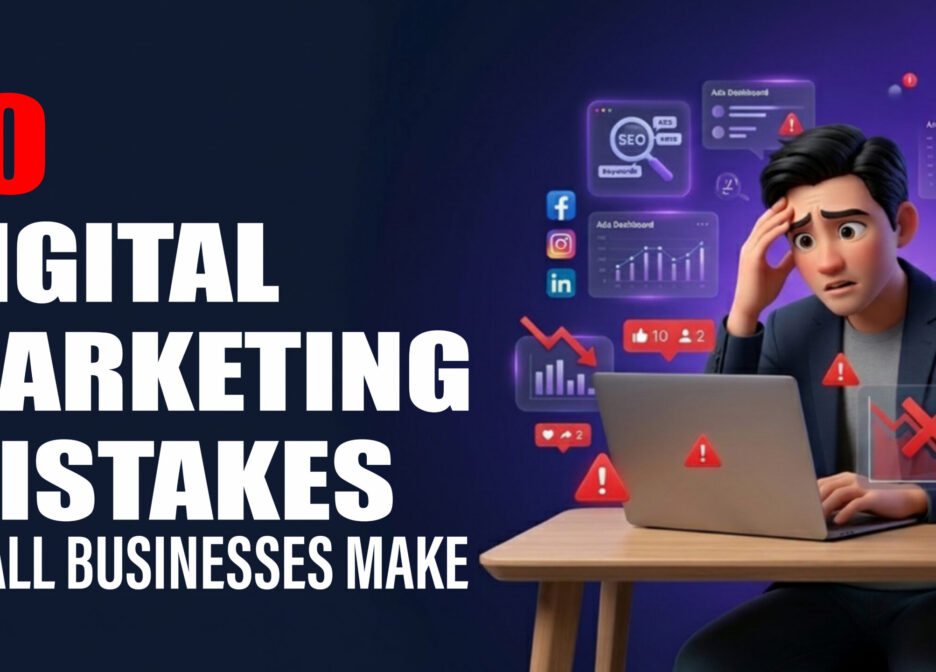
Top 10 Digital Marketing Mistakes Small Businesses Make (and How to Fix Them)
TL;DR — WHAT YOU’LL LEARN
Most small businesses in India are not failing at digital marketing because of a lack of effort — they are failing because of a small number of repeated, fixable mistakes. The 10 most costly are: no clear strategy, sending ad traffic to the homepage, ignoring local SEO, spreading across too many platforms, publishing without keyword research, not tracking ROI, treating the website as a brochure, neglecting email marketing, poor mobile experience, and ignoring online reviews. Each of these has a precise fix. This article covers all ten — with practical action steps you can implement this week.
QUICK ANSWER
The most common digital marketing mistake small businesses make is having no clear strategy — running random, disconnected campaigns without a defined audience, goal, or measurement framework. The result is wasted budget, poor ROI, and the frustrating feeling that ‘digital marketing doesn’t work’ — when the real problem is that it was never properly planned.
If you have ever felt like you are spending money on digital marketing but not seeing results, you are not alone. The vast majority of small businesses in India who struggle with digital marketing are not struggling because the channels do not work — they are struggling because of a small number of predictable, fixable mistakes that consistently cost leads, conversions, and budget.
The encouraging reality: every mistake on this list has a clear fix. None of them require a large budget. Most require a change in approach rather than more spending. Working through this list is essentially a free audit of your entire digital marketing operation.
Let us go through all ten.
76%
of small businesses say digital marketing is important but only 26% have a documented strategy
HubSpot, 2024
62%
of small business website traffic in India comes from mobile — yet most sites are not mobile-optimised
Statista, 2024
5×
more expensive to acquire a new customer than retain an existing one — yet most businesses ignore email marketing
Forbes, 2024
88%
of consumers trust online reviews as much as personal recommendations before making a local purchase decision
BrightLocal, 2024
The 10 digital marketing mistakes — and exactly how to fix them
Mistake 1 Having no clear digital marketing strategy
Why it hurts:
Running Google Ads one month, posting on Instagram the next, then trying SEO because a competitor mentioned it — this is what most small businesses do. Without a documented strategy that defines your target audience, your goals, your channels, your budget allocation, and how you will measure success, every campaign starts from zero. You accumulate no learning, no compounding authority, and no consistent brand presence. This is the foundational mistake that makes every other mistake on this list more expensive.
The fix:
Commit one afternoon to building a simple one-page marketing strategy: define your ideal customer (industry, city, business size, specific problem), set 3 measurable goals for the next 12 months (e.g., 50 inbound leads/month, first-page Google ranking for 5 keywords, 500 email subscribers), choose 2–3 channels to focus on exclusively, and set a monthly budget split across those channels. Review it quarterly. A strategy does not need to be complex — it needs to exist.
This is the single most expensive mistake on this list in terms of direct, measurable budget waste. When someone clicks your Google Ad or Meta Ad and lands on your homepage, they are hit with navigation menus, multiple services, multiple CTAs, and no direct answer to the specific thing they just searched for. Research consistently shows homepages convert paid traffic at 0.5–1.5%, while dedicated landing pages convert the same traffic at 5–15%. For a business spending ₹30,000/month on ads, this difference can mean the gap between 5 leads and 45 leads — from identical spend.
The fix:
Every paid ad campaign must have a dedicated landing page that matches the ad’s headline, speaks directly to the specific audience, removes all navigation, and has a single clear CTA. This is non-negotiable. If you are running Google Ads for ‘SEO services Delhi,’ the landing page headline should say something like ‘Rank Higher on Google in Delhi — Results in 90 Days’ — not ‘Welcome to [Agency Name].’
Mistake 3 Ignoring local SEO and Google Business Profile
Why it hurts:
56% of small businesses have not claimed their Google Business Profile (BrightLocal, 2024). For a business that serves local customers — a Delhi-based agency, a Bengaluru restaurant, a Mumbai clinic — this is an enormous missed opportunity. Google Maps is where purchase-intent local searches convert. A customer searching ‘digital marketing agency near me’ is ready to hire. Without a claimed, optimised GBP and a local SEO strategy, you are invisible at exactly the moment that customer is making a decision. Meanwhile, your competitor with a complete GBP and 50+ reviews is getting the call.
The fix:
Claim and fully optimise your Google Business Profile today — it takes under 30 minutes and is completely free. Add every service individually, write a keyword-rich description that includes your city, upload at least 10 real photos, and build a system to collect Google reviews after every client interaction (WhatsApp with a direct review link is the highest-converting method for Indian businesses). Then build a local SEO strategy that targets city-specific and ‘near me’ keywords across your website content.
Mistake 4 Trying to be on every social media platform at once
Why it hurts:
A small business with a team of 2–5 people attempting to maintain a consistent presence on Facebook, Instagram, LinkedIn, Twitter/X, YouTube, and WhatsApp simultaneously will do all of them poorly. Inconsistent posting, low-quality content, and no engagement strategy across six platforms is far worse than an excellent, consistent presence on two. Spreading too thin is one of the fastest ways to burn your marketing team out while generating no measurable results.
The fix:
Choose 2 platforms maximum based on where your specific audience actually spends time. For most small B2B businesses in India, the right combination is LinkedIn (for professional credibility) and WhatsApp (for client communication and referrals). For B2C local businesses, Instagram and WhatsApp is the typical winning combination. Master these two completely before considering others. Post consistently, engage with every comment, and measure results monthly.
Mistake 5 Publishing content without keyword research
Why it hurts:
Thousands of small businesses publish blog articles every week that no one reads — not because the content is bad, but because nobody is searching for those exact topics. Writing ‘Our Journey as a Digital Marketing Agency’ or ‘Why We Love What We Do’ generates zero organic search traffic. Every piece of content your business publishes should target a specific keyword that your ideal customers are actively searching for, with a volume and difficulty level that gives you a realistic chance of ranking. Without keyword research, content marketing is just an expensive journaling exercise.
The fix:
Before writing any article, run the topic through Google Keyword Planner or Ubersuggest. Confirm the keyword has at least 100 monthly searches in India and a keyword difficulty score below 40 for your current domain authority. Use the 5-step keyword research process to build a 12-month content calendar of pre-validated topics. This is exactly how the ProMentor content strategy was built — every article in this blog targets a specific, researched keyword. The result is compounding organic traffic rather than isolated posts with no visibility.
If you cannot answer the question ‘How much did your digital marketing cost per lead last month?’ then you are flying blind. Most small businesses track vanity metrics — likes, followers, impressions — but not the metrics that actually matter: cost per lead, lead-to-client conversion rate, revenue per marketing channel, and return on ad spend (ROAS). Without these numbers, you cannot make informed decisions about where to increase budget, where to cut, or what is actually working.
The fix:
Set up Google Analytics 4 (free) and connect it to your website immediately if you have not already. Define conversion events: form submissions, phone call clicks, WhatsApp button clicks, and purchase completions. In Google Ads, enable conversion tracking so every lead is attributed to the specific keyword and ad that generated it. Review your cost per lead and ROAS monthly — these two numbers should drive every budget decision you make. For organic channels, use Google Search Console to track keyword rankings and traffic growth over time.
Mistake 7 Treating the website as a brochure, not a conversion tool
Why it hurts:
The most common type of small business website in India is what marketers call a ‘brochure site’: a homepage with a hero image, a services list, an about page, and a contact form buried at the bottom. It tells visitors what the business does but gives them no compelling reason to act now, no social proof above the fold, no clear benefit-led headline, and no urgency. The result is a website that generates almost no inbound leads despite significant investment in design and development. A website that does not generate leads is not a digital asset — it is an expensive business card.
The fix:
Audit every page of your website against five questions: Does the headline immediately communicate what the visitor gains (not what you do)? Is there a clear, singular CTA visible without scrolling? Is there social proof (testimonials, reviews, results) above the fold? Does the page load in under 3 seconds on mobile? Is the form or contact mechanism as frictionless as possible (maximum 3 fields)? Fix any page that fails these tests before spending another rupee on driving traffic to it. A website that converts at 5% is worth 10 times more than one that converts at 0.5% — with identical traffic.
Email marketing has a median ROI of ₹3,600 for every ₹100 spent — the highest of any digital marketing channel (HubSpot, 2024). Yet the majority of small businesses in India have no email list and no email marketing strategy whatsoever. Every customer who contacts you, every visitor who downloads a resource, every lead who does not convert immediately — all of them represent potential subscribers who could become paying clients through a well-designed email nurture sequence. Not collecting these contacts is one of the most expensive forms of neglect in digital marketing.
The fix:
Start building your email list today with three actions: add a lead magnet to your website (a free checklist, guide, or audit offer relevant to your audience), add a simple 2-field email sign-up form to your homepage and blog, and set up a 5-email welcome sequence using a free tool like Mailchimp or Brevo. The welcome sequence should deliver your lead magnet, introduce your business, share your 2–3 most valuable blog articles, and close with a soft CTA for a free consultation. This automated sequence generates leads while you sleep.
Mistake 9 Poor mobile experience and slow page load speed
Why it hurts:
Over 78% of internet users in India access the web on mobile devices (TRAI, 2024). If your website takes more than 3 seconds to load on a mobile connection, you are losing more than half your visitors before they read a single word. If your website is not mobile-responsive — requiring pinch-zooming, horizontal scrolling, or featuring tiny tap targets — the visitors who do wait for it to load will leave immediately. Google also uses mobile page speed as a ranking factor, meaning a slow mobile site is suppressing your SEO rankings at the same time it is losing your paid traffic.
The fix:
Run your website through Google PageSpeed Insights (free) and target a mobile score of 80 or above. The three highest-impact fixes for most Indian small business websites: compress all images to under 150KB using TinyPNG or Squoosh, remove unnecessary third-party scripts and plugins, and switch to a lightweight WordPress theme or a purpose-built fast-loading website platform. If your current website cannot achieve a mobile PageSpeed score of 70+, rebuilding it on a faster platform is almost always worth the investment before spending further on paid ads.
Mistake 10 Ignoring online reviews and reputation management
Why it hurts:
88% of consumers trust online reviews as much as personal recommendations (BrightLocal, 2024). For a small business in India where trust and word-of-mouth are critical purchase drivers, your Google review score is often the first thing a prospective client checks after finding you in search results. A 3.8-star rating with 12 reviews will lose business to a 4.7-star rating with 60 reviews almost every time, regardless of quality of service. Worse, not responding to negative reviews — or responding defensively — signals to prospective clients that you do not care about customer experience.
The fix:
Build a systematic review generation process: after every completed project, send the client a personalised WhatsApp message with a direct Google review link and a brief, genuine request. Target at least 4–6 new reviews per month. Respond to every single review — thank positive reviewers specifically (mention the project or outcome they referenced) and respond to negative reviews calmly, professionally, and with a clear offer to resolve the issue offline. Never ignore a negative review. Each response is read by future prospective clients and signals your professionalism.
Your digital marketing self-audit: score your business
Rate yourself honestly against each mistake below. For every ‘No’ or ‘Partially,’ you have found an actionable priority for the next 30 days.
Area
Audit question
Yes
Partially
No — fix this week
Strategy
Do you have a documented 12-month digital marketing strategy?
✓
Landing pages
Does every paid ad campaign go to a dedicated landing page?
✓
Local SEO
Is your Google Business Profile fully complete and active?
✓
Social media
Are you focused on just 1–2 platforms and posting consistently?
✓
Keyword research
Does every blog article target a pre-researched keyword?
✓
Tracking
Do you know your cost per lead for each channel this month?
✓
Website
Does your homepage have a clear CTA and social proof above the fold?
✓
Email marketing
Do you have an email list and a welcome sequence running?
✓
Mobile speed
Does your site score 70+ on Google PageSpeed mobile?
✓
Reviews
Are you generating 4+ new Google reviews per month?
✓
How to use this audit: Any row with ‘No’ is a priority fix. Address them in the order they appear on this list — mistakes at the top (strategy, landing pages, local SEO) have the highest impact on every other area below them. A ‘No’ on strategy means every other fix is less effective until it is resolved.
Frequently asked questions
What is the biggest digital marketing mistake small businesses make?
The biggest and most foundational mistake is operating without a documented digital marketing strategy. Without a clear definition of your target audience, your goals, your channels, and how you will measure success, every campaign runs in isolation and generates no compounding return. A business with a clear strategy and modest budget consistently outperforms a business with a large budget and no strategy.
Why is my digital marketing not generating leads in India?
The most common causes, in order of frequency: (1) sending paid traffic to a homepage instead of a landing page, (2) targeting keywords or audiences that are too broad and not locally qualified, (3) a website that loads slowly or is not mobile-optimised, (4) no social proof (reviews, testimonials) visible to first-time visitors, and (5) running campaigns without conversion tracking, making it impossible to identify and fix what is underperforming. Start by auditing these five areas before increasing your marketing budget.
How much should a small business in India spend on digital marketing?
As a general guideline, small businesses should allocate 7–12% of their gross revenue to marketing. For a business with ₹50 lakh annual revenue, that is ₹3.5–6 lakh per year (₹30,000–50,000/month). Of this, 60–70% should typically go toward performance channels (SEO, Google Ads, Meta Ads) and 30–40% toward brand and content (social media, email, blog content). These ratios shift over time — as SEO compounds, paid ad dependency decreases.
Is digital marketing worth it for small businesses in India?
Yes — when done correctly. The key qualifier is ‘when done correctly.’ A small business with a clear strategy, properly optimised landing pages, active local SEO, and consistent content publication generates inbound leads at a fraction of the cost of traditional advertising — and those leads compound over time. The businesses that report poor ROI from digital marketing almost universally share 3–5 of the mistakes covered in this article. Fixing those mistakes, not increasing budget, is almost always the right first step.
How do I know if my digital marketing agency is doing a good job?
Hold your agency accountable to these four metrics, reviewed monthly: (1) Cost per lead — is it decreasing over time? (2) Organic traffic — is it growing month-over-month? (3) Keyword rankings — are your target keywords moving up in Google? (4) Conversion rate — is a higher percentage of visitors taking the desired action? If your agency cannot provide clear data on all four, that is a significant red flag. Good agencies measure everything and report transparently.
How long does it take for digital marketing to work for a small business?
It depends on the channel. Google Ads and Meta Ads can generate leads within days of launching, but require ongoing budget. Local SEO (Google Maps) typically shows results within 2–4 months of consistent effort. Organic SEO for competitive keywords takes 6–12 months. Email marketing generates results immediately for your existing contacts and compounds as your list grows. Blog content can take 3–6 months to rank but generates traffic indefinitely. The key insight: start everything simultaneously, use paid ads for immediate leads, and allow organic channels to reduce your cost per lead over time.
What digital marketing channels should a small business in India prioritise first?
The recommended starting order for most small businesses in India: (1) Google Business Profile — free, fast, highest local conversion intent. (2) A conversion-optimised website with mobile speed above 70. (3) Google Ads for immediate lead generation while organic builds. (4) Local SEO and blog content for compounding organic visibility. (5) Email marketing to nurture leads who do not convert immediately. (6) Social media on 1–2 platforms relevant to your audience. This sequence maximises ROI at each stage before adding the next channel.
Key takeaways
The single most foundational mistake is having no documented strategy — fix this before spending another rupee on any channel.
Sending paid ad traffic to your homepage instead of a dedicated landing page is the most expensive per-rupee mistake — it can reduce conversions by 5–10×.
Google Business Profile is the highest-ROI free marketing tool available — 56% of small businesses have not claimed it.
Focus on 1–2 social media platforms and do them excellently rather than being mediocre on six.
Every blog article should target a pre-researched keyword — content without keyword research generates no organic traffic.
If you cannot name your cost per lead for each channel this month, you cannot make good marketing budget decisions.
Email marketing has the highest ROI of any digital channel — ₹3,600 return per ₹100 spent (HubSpot, 2024) — yet most Indian small businesses do not use it.
78%+ of Indian internet traffic is mobile — a slow or non-responsive website is costing you leads and rankings simultaneously.
Google reviews are a direct local ranking factor and a primary trust signal — target 4–6 new reviews every month, and respond to every one.
Which of these 10 mistakes is your business making right now?
ProMentor Digital Solutions offers a free 30-minute digital marketing audit for small businesses across India. We identify exactly which mistakes are costing you leads — and give you a prioritised action plan to fix them.
Digital Marketing Strategist | Corporate Trainer | Founder of ProMentor Digital Solutions
Dr. Deepak S. Verma is a digital marketing strategist, educator, and corporate trainer with extensive experience in helping professionals, businesses, universities, and EdTech organizations build future-ready digital capabilities. As the Founder of ProMentor Digital Solutions, he specializes in digital marketing consulting, curriculum development, AI-enabled learning solutions, and workforce upskilling.
Over the years, he has trained thousands of learners and worked with leading organizations to design industry-focused training programs, develop academic content, and implement practical digital marketing strategies. Through his articles, Dr. Verma shares actionable insights on digital marketing, AI, career growth, and business transformation, making complex concepts easy to understand and apply.