The single most common digital marketing conversation ProMentor has with new clients goes something like this: ‘We spent ₹1.5 lakh on a new website six months ago. It looks great. But we have had almost no enquiries from it.’
This is not a rare situation. It is the norm. And it almost always comes down to the same set of problems: the website was built to impress rather than to convert, it was not optimised for search, it loads too slowly on mobile, and there is no clear path for a visitor to become a lead.
This guide solves that problem. It tells you exactly what a small business website needs to generate leads in India in 2026, what you can safely skip until you grow, how much a properly built website should cost, and the five design mistakes that most consistently cost small businesses enquiries every single day.
88% of online consumers are less likely to return to a site after a bad experience Amazon Web Services, 2024 | 3 sec maximum load time before 53% of Indian mobile users abandon a page Google India, 2024 | 75% of consumers judge a business’s credibility based on their website design Stanford Web Credibility Research, 2024 | 62% of Indian small businesses have a website but fewer than 20% receive regular enquiries from it NASSCOM SME Report, 2024 |
The most important mindset shift: a website is a sales tool, not a brochure
Most small business websites in India are built as digital brochures — a place to list your services, show your team, and display contact details. That is not wrong, but it is incomplete. A brochure tells people about you. A sales tool converts them into leads.
The difference between these two approaches is enormous in practice. A brochure website might have a beautiful homepage, detailed service descriptions, and a full team page — but if there is no clear reason for a visitor to act now, no compelling CTA above the fold, and no frictionless way to get in touch, it will generate almost no leads regardless of how much traffic it receives.
Before planning any aspect of your website, ask one question: ‘What is the single action I want a visitor to take when they land on this page?’ Book a consultation. Send a WhatsApp message. Fill in an enquiry form. Call our number. Every design and content decision should serve that action. Everything that distracts from it should be reconsidered.
What your small business website actually needs: the 6 non-negotiables
These six elements are non-negotiable for any small business website that is expected to generate leads. If your current website is missing any of them, fixing them should be your first priority — before redesigning, adding new pages, or running any paid advertising.
1. A clear value proposition above the fold Why you need it: The average visitor decides within 3–5 seconds whether to stay on your website or leave. Your homepage headline must answer three questions immediately: What do you do? Who do you do it for? Why should they choose you? A generic headline like ‘Welcome to [Business Name]’ answers none of these. A specific headline like ‘Google Ads and SEO for small businesses in Delhi — More leads, lower cost per click’ answers all three. What this means practically: Your headline and subheadline must be visible without scrolling on both desktop and mobile. They must use your customer’s language, not industry jargon. They must focus on the outcome the customer gets, not the features of your service. India cost context: Copywriting a strong value proposition: included in ProMentor’s web design service. Standalone copywriting for a homepage headline: ₹3,000–8,000. This is the highest-ROI website investment available. |
2. Mobile-responsive design with fast load speed Why you need it: Over 78% of Indian internet users access the web on mobile (TRAI, 2024). If your website does not display correctly on a smartphone — requiring pinch-zooming, horizontal scrolling, or featuring unclickable small buttons — you are losing the majority of your potential leads before they read a single word. What this means practically: Every element of your website must resize and reflow correctly on screens from 320px to 1440px wide. Buttons must be at least 44×44px (large enough to tap with a finger). Text must be readable without zooming. Images must not overflow the screen. Your Google PageSpeed mobile score must be 70 or above. India cost context: A properly mobile-responsive WordPress website built on a quality theme: ₹15,000–35,000. A website with broken mobile layout is not a website — it is a liability. Test any existing website at search.google.com/test/mobile-friendly (free). |
3. A simple, frictionless contact mechanism Why you need it: Your website exists to generate contact. Every page should make it easy to take the next step — without hunting through menus, filling in excessive form fields, or navigating away from the content that brought the visitor to you in the first place. What this means practically: Your primary contact mechanism should be visible on every page — ideally in the header and at the end of every page. For most Indian service businesses, a WhatsApp link converts at higher rates than a traditional contact form. A 3-field form (Name, Phone, What can we help with?) converts at 2–3× the rate of a 7-field form. Include your phone number in clickable text (not an image) so mobile visitors can call directly by tapping. India cost context: A WhatsApp business link costs nothing. A simple contact form is included in every website builder. The mistake is not in the cost — it is in adding too many fields, burying the form at the bottom, or not including a WhatsApp option at all. |
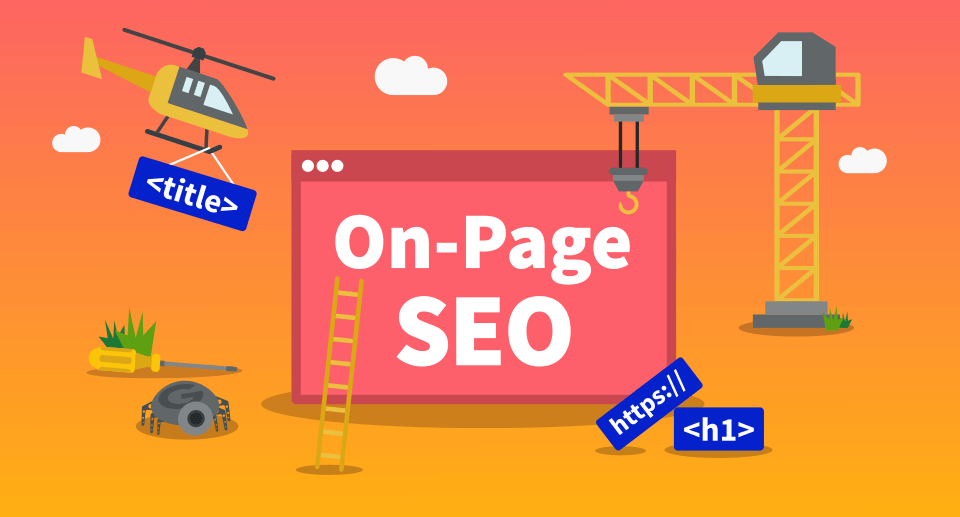
4. Basic on-page SEO on every page Why you need it: A website that search engines cannot find is a website that does not generate organic leads. Every page of your website needs a unique, keyword-targeted title tag, a compelling meta description, a clear H1 heading, descriptive image alt text, and a clean URL structure. Without these, your pages will not rank for any search queries regardless of how well-designed they are. What this means practically: Before launching any website, complete the on-page SEO checklist for every page: unique title tags (50–60 chars), unique meta descriptions (150–160 chars), one H1 per page with the primary keyword, all images with alt text, and a sitemap submitted to Google Search Console. India cost context: On-page SEO setup during website build: included in ProMentor’s web design service. A free plugin like Yoast SEO (WordPress) makes this manageable without developer knowledge after the initial setup. |
5. Google Analytics 4 and Search Console connected Why you need it: A website without analytics is a business operating without a scoreboard. You cannot improve what you cannot measure. Google Analytics 4 tells you how many visitors you are getting, where they come from, which pages they visit, and what actions they take. Google Search Console tells you which search queries are bringing people to your site and which pages are ranking. What this means practically: Both tools are completely free. Both should be connected before your website goes live — not as an afterthought months later. Set up at least one conversion event in GA4 (form submission, WhatsApp click, or phone call click) so you can track which traffic sources are generating actual enquiries. India cost context: Google Analytics 4 and Search Console: completely free. A developer typically charges ₹3,000–5,000 to set up GA4 with conversion tracking and Search Console. This is a one-time cost that pays for itself in week 1 by telling you what is working. |
6. An SSL certificate (HTTPS) Why you need it: SSL (Secure Sockets Layer) is the technology that shows the padlock icon in your browser address bar and changes your website address from http:// to https://. It encrypts data between your website and your visitors. Google has used HTTPS as a ranking signal since 2014 and Chrome displays a ‘Not Secure’ warning on non-HTTPS websites, which dramatically reduces visitor trust and conversion rates. What this means practically: If your website address begins with http:// instead of https://, potential clients see a ‘Not Secure’ warning when they visit — particularly prominent on mobile Chrome. This single issue can reduce your conversion rate by 20–40%. India cost context: Free SSL certificates are available from Let’s Encrypt and are included by default with most Indian web hosting providers (Hostinger, BigRock, SiteGround). If your hosting provider does not include SSL, change providers. There is no reason to pay for SSL in 2026. |
What you can safely skip (until you actually need it)
The following features are frequently sold to small businesses as essential. Most are not — at least not at the start. Investing in these before you have the basics working correctly is a misallocation of budget that delays your lead generation without improving it.
A custom-coded website from scratch Why you can skip it (for now): Custom code is slower to build (3–6 months vs 3–6 weeks), more expensive (₹1,50,000–5,00,000+ vs ₹15,000–50,000), and harder to update without a developer. For 95% of small businesses, WordPress with a quality theme or a website builder like Webflow delivers identical results for a fraction of the cost. What to do instead: Use WordPress with Elementor or a premium theme (Astra, GeneratePress). You get full design flexibility, excellent SEO capabilities, and complete content control without custom code. |
A chatbot or live chat widget Why you can skip it (for now): Chatbots and live chat widgets add page weight (slowing load speed), create maintenance overhead, and require ongoing attention to be effective. For most Indian small businesses, a well-placed WhatsApp button generates more conversations at lower complexity and zero monthly cost. What to do instead: Add a WhatsApp Business link to your header and footer. For most Indian service businesses, this outperforms any chatbot in enquiry volume and conversion rate. |
A blog before your core pages are optimised Why you can skip it (for now): Starting a blog before your homepage, service pages, and contact page are fully optimised for conversion and SEO is building the roof before the foundation. Every hour spent on blog content when your core pages are underperforming is an opportunity cost. What to do instead: Fully optimise your 5–7 core pages first (homepage, 3–4 service pages, about, contact). Once these are generating leads and ranking for their primary keywords, launch the blog as a lead generation multiplier. |
Animations, parallax scrolling, and video backgrounds Why you can skip it (for now): Heavy animations, parallax scrolling effects, and full-screen video backgrounds are among the most common causes of poor PageSpeed scores on Indian small business websites. They add seconds to load time on mobile connections — which accounts for 78%+ of your traffic — and do not meaningfully improve conversion rates. What to do instead: Use a clean, fast-loading design with high-quality static images. Speed converts better than visual complexity. A website that loads in 1.5 seconds consistently outperforms one that loads in 4 seconds regardless of which one looks more impressive. |
Complex multi-level navigation menus Why you can skip it (for now): A navigation menu with 8–10 items, multiple dropdowns, and sub-menus creates decision paralysis for visitors and makes mobile navigation frustrating. More importantly, it dilutes the primary CTA by giving visitors too many directions at once. What to do instead: Limit your navigation to 5–6 items maximum: Home, Services (or a dropdown with 3–4 services), About, Blog (once launched), Contact. Your most important CTA (Book a Call, WhatsApp Us) should be a button in the navigation, not just a menu item. |
How much should a small business website cost in India? (2026 honest guide)
Website pricing in India varies enormously — from ₹5,000 freelancer builds to ₹3,00,000+ agency projects. Here is what you should realistically expect to pay at each level, and what you should get for that investment:
Budget tier | What you get | Best for | Watch out for |
₹5,000–15,000 (Budget) | Template website, basic pages, minimal customisation, typically on Wix or a free WordPress theme | Absolute minimum viable web presence while you validate your business model | Very slow speeds, poor SEO setup, no conversion optimisation, difficult to update |
₹15,000–35,000 (Standard) | WordPress + premium theme, 5–7 custom pages, on-page SEO setup, mobile optimisation, Google Analytics, contact form, 1 round of revisions | Most small businesses — the best ROI tier for a business-generating website | Ensure the agency includes on-page SEO, not just design. Ask for PageSpeed scores before sign-off |
₹35,000–75,000 (Professional) | Custom design, 8–15 pages, conversion optimisation, full SEO setup, blog setup, schema markup, 2–3 rounds of revisions, 3 months support | Established businesses or those launching with a significant digital marketing budget | Ensure conversion rate optimisation is explicitly included — not just visual design |
₹75,000–1,50,000+ (Premium) | Full brand integration, 15+ pages, e-commerce or booking functionality, custom features, extensive content writing, SEO campaign launch | Businesses with multiple services, product catalogues, or complex booking requirements | Define scope extremely clearly before signing. Scope creep is the primary risk at this tier |
The most important budget insight: A ₹20,000 website that is properly optimised for SEO, loads in 1.5 seconds on mobile, and has a WhatsApp CTA will generate more leads than a ₹70,000 website with visual animations, slow load speed, and no SEO foundation. Spend more on strategy and conversion than on visual complexity.
5 website design mistakes that cost Indian small businesses the most leads
No clear call to action above the fold The most common website mistake in India: the homepage has a beautiful hero image, a tagline, and a services overview — but the visitor has to scroll past three sections to find a way to contact you. By then, most visitors have left. 70% of website visitors never scroll past the first screen. Fix: Add your primary CTA button (Book a Free Call, WhatsApp Us Now, Get a Free Quote) in your homepage hero section, positioned prominently above the fold. Repeat this CTA at the end of every service page. Use a contrasting button colour that stands out from the rest of the design. |
Sending paid traffic to the homepage When someone clicks your Google Ad for ‘SEO agency Delhi’ and lands on a homepage that talks about all your services in general terms, the message match fails. They searched for something specific and found something generic. They leave. Your ad spend is wasted. Fix: Every paid ad campaign must go to a dedicated landing page that mirrors the ad’s specific headline, addresses the specific audience, removes navigation, and has one CTA. This is one of the highest-ROI changes any small business can make to an existing ad campaign. |
Slow page load speed on mobile The average Indian small business website loads in 6–8 seconds on a mobile 4G connection. At that speed, more than 50% of visitors abandon before the page loads. This single issue is costing businesses more leads than any other technical factor — and it is almost always caused by uncompressed images, too many plugins, and unoptimised hosting. Fix: Compress all images to under 150KB using TinyPNG (free). Remove any plugins or scripts that are not actively generating value. Choose a hosting provider with Indian data centre servers (Hostinger India, SiteGround, Digital Ocean Mumbai) for faster Indian load speeds. Target a PageSpeed mobile score of 70+. |
No trust signals visible without scrolling Trust is the primary barrier between a visitor who reads your website and one who contacts you. If your credentials, client count, years of experience, Google review rating, or client logos are buried at the bottom of your homepage, visitors who are not yet convinced leave before they find them. Fix: Move your primary trust signal above the fold: a Google rating badge, a client count (‘Trusted by 200+ small businesses in Delhi’), years in business, or a single powerful client testimonial with a specific result. Test placing one trust element directly below your headline and measure whether your enquiry rate improves. |
A contact form that asks for too much information Forms with more than 5 fields have dramatically lower completion rates. Each additional field reduces conversions by 10–15%. A form asking for name, email, phone, company name, website URL, budget range, how you heard about us, and a description of your requirements will generate a fraction of the enquiries that a 3-field form generates — even with identical traffic. Fix: Reduce your primary contact form to 3 fields: Name, Phone Number, and one qualifying question (a dropdown, not a text field). You can gather additional information in the follow-up call. Add a WhatsApp CTA as an alternative to the form — many Indian users prefer WhatsApp over email forms for initial contact. |
Which website platform should a small business in India use?
The platform question is one of the most common ones ProMentor receives. Here is the honest answer for each major option:
Platform | Best for | Cost | SEO capability | Ease of use |
WordPress + Elementor | Most small businesses — the most flexible and SEO-capable option | Hosting: ₹300–800/month + domain: ₹700–1,200/year + theme: ₹4,000–10,000 one-time | Excellent — full control over all SEO elements | Medium — some learning curve but manageable |
Wix | Very small businesses or solo professionals needing a quick presence | Free (with Wix ads) or ₹200–700/month for business plans | Good — improving but still limited vs WordPress | Very easy — true drag-and-drop |
Shopify | E-commerce businesses selling products online | Basic: ₹2,000/month + 2% transaction fee | Good for product pages, limited for blog SEO | Easy for product management |
Squarespace | Visually-driven businesses: photographers, designers, creative agencies | ₹1,800–3,600/month | Good — but less flexible than WordPress for SEO | Very easy — clean templates |
Custom HTML/React | Technology companies, SaaS products, businesses with complex requirements | Development: ₹1,50,000–5,00,000+ one-time | Excellent when done correctly | Requires developer for all changes |
ProMentor’s recommendation for most Indian small businesses: WordPress with Elementor and a lightweight theme (Astra or GeneratePress) offers the best combination of SEO capability, design flexibility, and cost-effectiveness. It powers 43% of all websites globally for a reason. The learning curve is real but manageable — and ProMentor’s web design service handles all setup so you start with a properly optimised foundation.